
Biopsychosocial Reframed 2.0
Biopsychosocial Reframed 2.0
This course includes
The instructors
Notice
This course is now open for early registration. Register today to lock in the launch price. Course content will start to be added by November 30, 2026, and you’ll get access to each new section as soon as it goes live.
Overview
Carolyn has taught this course for the past 15 years. It has received serious updates over the past 5 years and has become a brand-new course. If you took this course more than 3 years ago, your patients deserve an updated version. It is clearer, simpler, and more relevant than ever given the state of the evidence for treating persistent pain.
Persistent pelvic and musculoskeletal pain cannot be fully understood, or effectively treated, through a biomechanical lens alone. Although physiotherapists receive extensive training in anatomy, structure and movement, many clinicians find it challenging to translate the biopsychosocial model from theory into everyday practice.
This comprehensive course provides a practical, evidence-informed framework for assessing and treating the whole person. Participants will examine how biological, psychological and social factors interact to influence pain, disability and recovery. The course challenges common assumptions about pain, posture, core strength, imaging findings and tissue damage, while exploring how clinician language and treatment choices can either support recovery or unintentionally reinforce fear, dependency and a sense that the body is broken.
The Fit-for-Purpose Model
The Fit-for-Purpose Model offers clinicians a structured approach to persistent pain through three interconnected domains:
- Conviction: beliefs, expectations, emotions and psychological flexibility
- Connection: sensory-motor awareness, regulation and nervous-system adaptability
- Conditioned: physical capacity, mobility, strength and tissue health
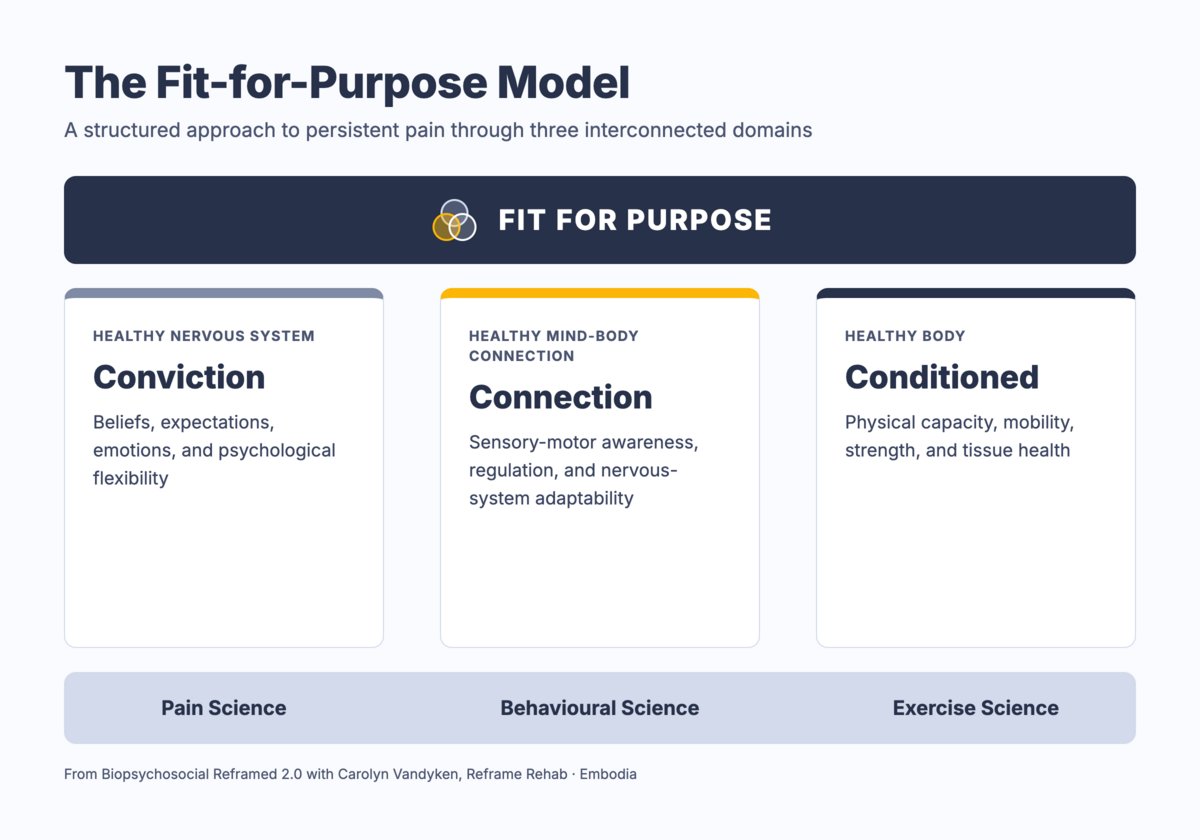
Participants will learn to assess these domains using clinical conversations, validated screening tools and physical examination findings. Treatment can then be matched to each patient’s presentation, preferences and readiness for change.
The course explores evidence-informed strategies including pain education, cognitive and behavioural skills, sensory-motor retraining, graded exposure, cardiovascular exercise, meditation, breathing practices, yoga, Qi Gong, expressive writing and progressive relaxation. Manual therapy and other passive interventions are reframed as potential adjuncts within a broader active rehabilitation plan,not as stand-alone solutions.
Emphasis is placed on patient-centred communication and a collaborative partnership that moves clinicians away from the role of “fixer.” Participants will develop greater confidence in discussing psychosocial contributors without dismissing the patient’s physical experience, recognizing factors that fall within physiotherapy scope, and determining when interdisciplinary referral is appropriate.
Clinical barriers, including limited appointment time, patient and clinician beliefs, uncertainty, and conflicting approaches within healthcare teams, will be addressed throughout the course. Participants will leave with practical strategies for making realistic, incremental changes that bring biopsychosocial care into everyday pelvic and musculoskeletal practice.
Learning Objectives
Upon completion of this course, participants will be able to:
- Explain why a biopsychosocial approach is necessary for the assessment and treatment of persistent pelvic and musculoskeletal pain.
- Recognize and challenge common pain myths related to tissue damage, posture, core strength, structural “wear and tear,” and imaging findings.
- Describe the relationship between pain, sensitization, psychosocial distress, sensory-motor dysregulation, physical conditioning and disability.
- Apply the Fit-for-Purpose Model to assess the interconnected domains of Conviction, Connection and Condition.
- Screen for relevant psychosocial and sensory-motor factors in all patients with persistent pelvic or musculoskeletal pain—not only those perceived as complex.
- Select and use validated questionnaires, including the DASS-21, 3PSQ, Central Sensitization Inventory, Insomnia Severity Index and Fremantle questionnaires, to support clinical reasoning.
- Interpret screening results within the broader clinical presentation without using questionnaires as stand-alone diagnostic tools.
- Identify factors within physiotherapy scope and recognize when referral to another healthcare professional is indicated.
- Match evidence-informed interventions to the individual patient’s pain drivers, goals, preferences, readiness and functional needs.
- Integrate psychologically informed strategies such as pain education, cognitive and behavioural skills, graded exposure, mindfulness, breathing, relaxation and expressive writing into physiotherapy practice.
- Use movement-based approaches, including cardiovascular exercise, sensory-motor retraining, yoga and Qi Gong, to address nervous-system sensitivity, altered body awareness, generalized tension and reduced physical capacity.
- Position manual therapy and other passive modalities as adjuncts within an active, multimodal treatment plan while minimizing messages that may promote fear, dependency or a “broken body” mindset.
- Communicate pain science in a validating, patient-centred manner that supports self-efficacy, therapeutic alliance and shared decision-making.
- Develop an individualized, interdisciplinary treatment plan that integrates biological, psychological and social contributors to persistent pain.
- Identify barriers to biopsychosocial implementation and create a realistic plan for introducing incremental changes into clinical practice.
- Reflect on personal clinical assumptions, become more comfortable with uncertainty, and adopt an ongoing approach to professional growth and changes.
Audience
This course is open to all healthcare professionals. There are no pre-requisites.
Registration and What's Included
Regular price: CA$299
Launch price: CA$249 until December 21st, 2026.
Register during the launch window to save $50.
Already own THE Biopsychosocial Bundle? You can upgrade to Biopsychosocial Reframed 2.0 for CA$99. Email us at support@embodiaapp.com to get your code!
What’s Included
Biopsychosocial Reframed 2.0 is the fully updated version of Carolyn’s course, rebuilt for clinicians managing persistent pelvic and musculoskeletal pain. Watch it at your own pace, return to sections when a tricky case comes up, and bring the Fit-for-Purpose Model straight into your next patient session.
- 12 hours of recorded teaching with Carolyn Vandyken
- 16 CEUs on completion
- A companion resources course with 8 hours of material, so you can dig deeper where it matters most to your caseload.
- A certificate of completion
- Lifetime access
The instructors
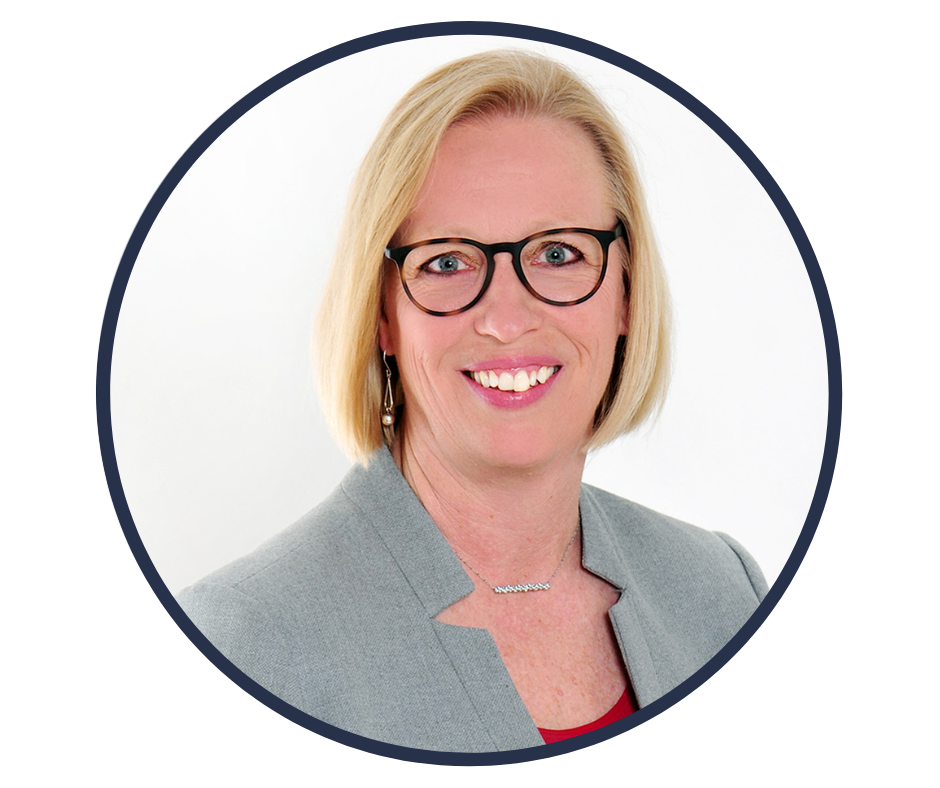
BHSc (PT), CredMDT, CCMA
Carolyn is the co-owner of Reframe Rehab, a teaching company engaged in breaking down the barriers internationally between pelvic health, orthopaedics and pain science. Carolyn has practiced in orthopaedics and pelvic health for the past 40 years. She is a McKenzie Credentialled physiotherapist (1999), certified in acupuncture (2002), and obtained a certificate in Cognitive Behavioural Therapy (CBT) in 2017.
Carolyn received the YWCA Women of Distinction award (2004) and the distinguished Education Award from the OPA (2015). Carolyn was also awarded the Medal of Distinction from the Canadian Physiotherapy Association in 2021 for her work in pelvic health and pain science.
Carolyn has been heavily involved in post-graduate pelvic health education, research in lumbopelvic pain, speaking at numerous international conferences and writing books and chapters for the past twenty years in pelvic health, orthopaedics and pain science.

Online Teaching Company
We are a passionate group of highly trained clinicians who champion virtual, live online education courses to develop a biopsychosocial framework for your clinical practice. Our mission is to break down the silos in clinical practice between musculoskeletal pain, pelvic pain, pain neuroscience education, and psychology by providing timely, cost-effective, live online learning opportunities from the world's leading clinical educators on these topics.
Interested in learning more about Reframe Rehab or taking a course with us? Check us out on Instagram @reframerehab or visit our website https://reframerehab.com/ to view all our course offerings.
Is a certificate of completion included with this course?
Once you have completed the course, a certificate of completion (including learning hours and course information) will be generated. You can download this certificate at any time. To learn more about course certificates on Embodia please visit this guide.
This can be used for continuing education credits, depending on your professional college or association. If this course has been approved for CEUs in specific jurisdictions, it will be noted on the course page and CEU information may be added to your course certificate. Please read this guide for more information.
Has this course been approved for CEUs (Continuing Education Units) for Physical Therapists and Physical Therapy Assistants in the US?
Yes, Embodia is a rule-approved CE provider of the PT Board of Florida (# 50-54793), a licensed CE sponsor of physical therapy continuing education by the Illinois Department of Financial & Professional Regulation (IDFPR #216.000415), an approved provider of continuing education by APTA Massachusetts, an approved provider of the Oklahoma Board of Medical Licensure & Supervision - Physical Therapy (#50-54793), and an approved provider of continuing education for Physical Therapists and Physical Therapist Assistants in California (CA) by CEUapproval.com, a recognized approval agency of the Physical Therapy Board of CA.
Courses approved by other state boards in the following jurisdictions are likely accepted for licensure credit based on the state regulation:
AL | AK | AR | CO | CT | DE | GA | HI | ID | IL | IN | IA | KS | KY | ME | MA | MI | MO | MT | NE | NH | NC | ND | OK | OR | PA | RI | SC | SD | UT | VT | VA | VI | WA | WI | WY
Please reach out to your state licensing board to confirm. If you have a specific question about CEU approval for this course in your state, please direct your inquiry to info@ceuapproval.com
The following states are not pre-approved: AZ, DC, LA, MD, MN, MS, NM, NV, NY, NJ, OH, TX, WV
Participants licensed in states not pre-approved may file for individual approval using the instructions on this document.